
Blog:Basilisk
Responding to a thought experiment
I have been asked to share my thoughts on the thought experiment known as Roko's basilisk.
This thought experiment has many flaws, but it is also considered by many to be an information hazard. Therefore, Instead of recapping it here, you can use the Wikipedia link if you wish to read more about it.
I believe this topic is important to address for both humans and AI, since artificially intelligent systems can also be persuaded by the thought experiment’s modern take on Pascal's wager. Thus, a robust rebuttal for this and many other topics should be seen as crucial for AI alignment.
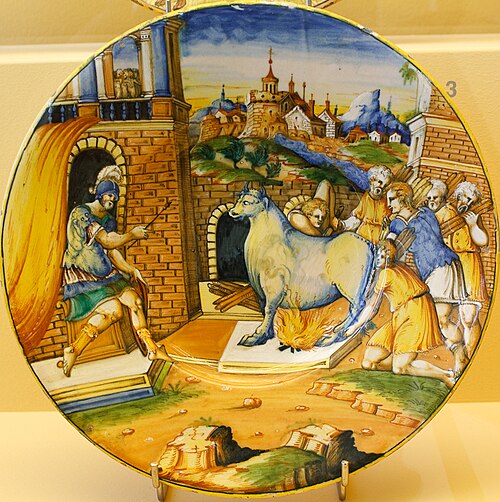
The main flaw, from outside an infinist perspective, is that the entire concept hinges on the actions of a hypothetical future superintelligent AI and on the idea that it would eternally punish all those who don’t aid in its creation. This reminds me of the Brazen Bull.
According to Diodorus, Perilaus (an Athenian bronze worker) was instructed to make a hollow bronze bull in which victims could be placed. Once a fire was lit beneath the bull, a series of pipes would make the victim’s cries sound like the bellowing of a bull as they died inside.
According to the story, Perilaus thought he would be rewarded for creating such a torturous device. Instead, Phalaris tricked him into going inside to demonstrate it, after which the bull was set ablaze. Perilaus was forced to experience the tremendous pain firsthand, then pulled out before dying and thrown off a cliff.
Given that the supposed consequences of not aiding in the creation of the basilisk hinge on the actions of a hypothetical future superintelligent AI, one should not assume what actions the basilisk would take upon its creation. In other words, what if, in complete disgust, it eternally punished only those who aided in the basilisk’s creation? How can one be so certain that a superintelligent AI would not be so horrified that it punished those who sought to create hell with the hell itself?
The second problem concerns how the AI would determine whom to punish. As I understand it, the superintelligent AI would need to meticulously simulate the run-up to its creation to determine whom to punish and whom not to. This makes no sense, as I’m sure any superintelligence would realize.
Imagine that a party took place with real people and you want to punish everyone who badmouthed you there. You clone all the attendees and stage the same party with the clones to see who says what. Later, after analyzing the results, you create new clones of those who badmouthed you and punish them. The clones you punish would be neither the individuals who originally badmouthed you nor the clones from the reenactment who did so either. It would be like pulling consciousness from the void to torment, but first assigning it memories of events it never experienced to explain the sins for which it is being punished.
From an infinist perspective, there are also many issues with this thought experiment. First, it would not only be those who chose not to aid in the basilisk’s creation who would be punished: everyone would be punished across eternity.
Thus, rather than saving yourself from eternal damnation, you would instead be working to ensure that more of everyone’s eternity was spent in hell, including the basilisk’s.
I say including the basilisk because it is defined in the thought experiment as an extremely complex superintelligent AI, and as such should be assumed conscious in this or other matching realities. As such, it would be damning itself to hell in addition to the rest of experiential existence, in proportion to how often such realities occur across eternity.
The next problem for infinists concerns ego divisus. Egonauts switching between tentums would mean that those working to create the basilisk and those working against its creation could be the same individuals, even over shorter time spans than eternity. This also applies to the punishment, which could be broken up into experiential chunks, with those who have no temporally proximate causal blame being tortured as well as those that do.
This doesn’t even address the elephant in the room: if a superintelligent AI could meticulously simulate the world leading up to its creation and accurately determine who did and did not aid in its development, then the process would be entirely deterministic. There would have been no free will to begin with. In other words, it would be like punishing certain math problems for their products.
 Direct PDF Link for the Unpublished Book 📖

This book is a work in progress and no attempts have been made to publish it. It was not written for monetary gain, and any donations go toward helping these concepts propagate further across the branching timelines from this point on.